Lintel repair and replacement

A cracked or sagging window head usually means the lintel underneath has failed. We support the wall, take out the old lintel, fit a new steel, Catnic or concrete one and rebuild the brickwork above to match.

  • 18 years in the trade
  • Free quotes
  • Steel, Catnic and concrete
  • Cavity trays and weep vents

Get a free quote

Send us the details on WhatsApp, or by email if you prefer. We reply with a price or a time to visit.

Prefer to talk? Call 07487 625926

What a failing lintel looks like from outside

Every window and door opening in a brick wall has something spanning the top of it to carry the bricks above. In most houses that is a steel or concrete lintel hidden behind the brickwork, while some older homes have stone heads, brick arches or even timber. When that support weakens, the brickwork above starts to drop and the signs appear on the outside of the house.

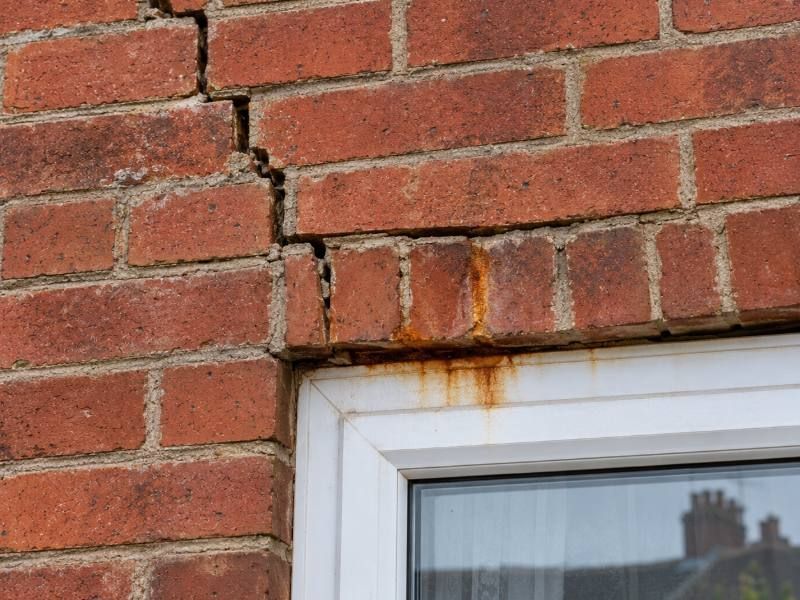
The usual giveaway is a stepped crack running diagonally up from the top corner of the frame. You may also see a soldier course or brick arch sagging in the middle, rust stains bleeding through the joints or a window that has started to bind. Steel lintels swell as they corrode and can lift and crack the course of bricks resting on them.

Filling the crack only hides it. Our lintel work deals with the cause by repairing or replacing the lintel and then rebuilding the brickwork. Bricks that have cracked around the opening can be swapped through our brickwork repairs service, and the new joints are pointed in the same way as on a brick repointing job.

Our lintel repair and replacement guide goes through each stage in more detail. You can also look up your town on the areas we cover page.

What lintel replacement includes

Safe support for the wall first, then a properly bedded lintel and brickwork to match.

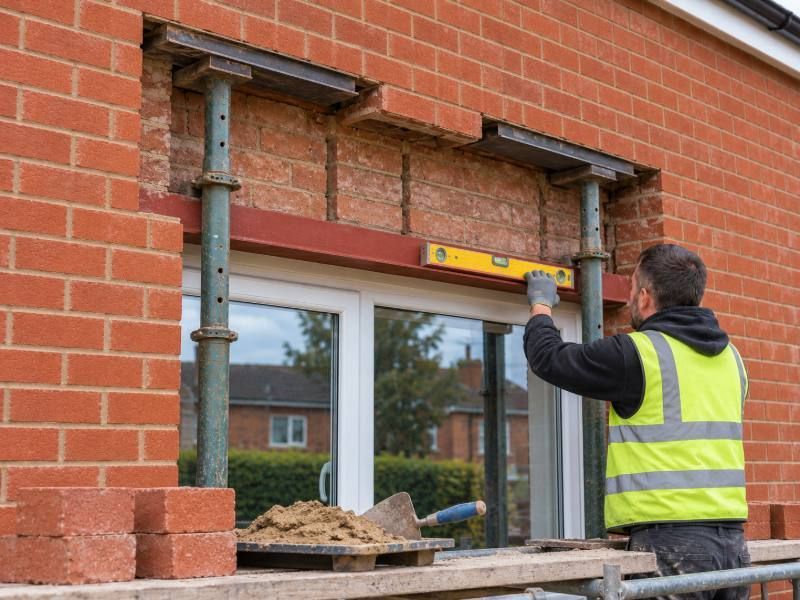
Window opening with acrow props and strong boys holding the brickwork above

Supporting the wall and removing the old lintel

Nothing comes out until the brickwork above the opening is carried on props.

  • Opening and crack inspected first
  • Strong boys set through the joints
  • Acrow props under each strong boy
  • Brickwork above taken down with care
  • Sound bricks cleaned for reuse
  • Failed lintel cut out
  • Bearings checked at each end
  • Window frame protected throughout
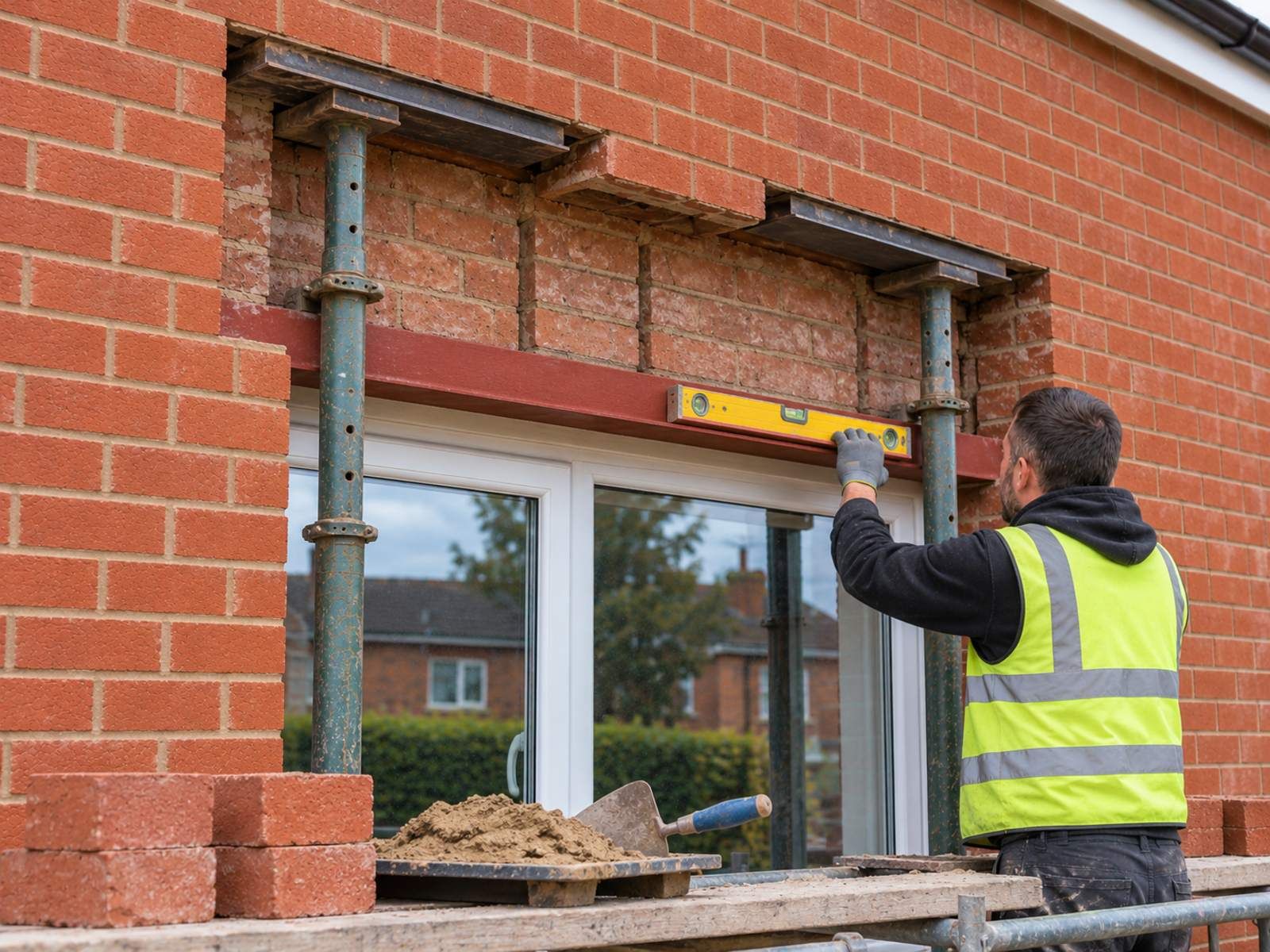
New steel lintel bedded over a window opening with a cavity tray above

Fitting the new lintel and rebuilding

The new lintel is bedded level, the wall is closed up and the props stay until the mortar has set.

  • Steel, Catnic or concrete lintel
  • Bedded level at both ends
  • Full bearing on solid brickwork
  • Cavity tray where the wall needs one
  • Weep vents to let water out
  • Rebuilt in matching bricks
  • Pointing matched to the wall
  • Props out once the mortar sets

Lintel replacement prices

Priced by the length of the lintel. Slide to the width of your window or door opening plus the bearing at each end.

1 metre 4 metres
Which side
Lintel replacement £1,850 1 to 1.5 metres, inside and out
Send this on WhatsApp

Each price covers the inside and outside lintel, propping, rebuilding the brickwork above and pointing to match. If only one side needs doing, it is half price. Openings under 1 metre or over 4 metres are priced from photos.

See every lintel price
Lintel length Inside and out One side only
1 to 1.5 metres £1,850 £925
1.5 to 2 metres £2,150 £1,075
2 to 2.5 metres £2,450 £1,225
2.5 to 3 metres £2,750 £1,375
3 to 3.5 metres £3,150 £1,575
3.5 to 4 metres £3,450 £1,725

The steps of a lintel replacement

  1. Check the opening

    We look at photos or visit to confirm the lintel is the cause and decide what type suits the wall.

  2. Needle and prop

    Strong boys are slotted through the brickwork and carried on acrow props before anything comes out.

  3. Swap the lintel

    Brickwork comes down, the old lintel is removed and the new one goes in level with a cavity tray if required.

  4. Rebuild and finish

    The wall above is rebuilt and pointed, and the props come out after the mortar has gained strength.

Why lintel work needs a bricklayer

Every common lintel type

Steel, Catnic box and cavity lintels and concrete lintels are all part of our work.

Propped the right way

The wall sits on strong boys and acrows so it cannot move while the opening is bare.

Water kept out

In cavity walls we fit a cavity tray and weep vents so rain is sent back outside above the window.

Brickwork that matches

We reuse sound bricks where we can, match the rest and point to suit the wall.

Building control advice

We tell you when it is worth checking with building control before work starts.

18 years of window heads

Rebuilding brickwork over openings has been part of our trade for 18 years.

Before and after: replacing a failed window lintel

Cracked window head rebuilt over a new lintel before
Before
Cracked window head rebuilt over a new lintel after
After

Bearings, cavity trays and building control

A lintel only works if each end sits on solid brickwork with enough length to spread the load. That length is called the bearing, and short or crumbling bearings are a common reason older lintels crack. When we fit a new one we bed it level on a full bed of mortar at both ends, check it is square to the wall and make sure the brickwork underneath is sound.

In a cavity wall, rain that gets into the outer leaf runs down the inside face of the bricks. Without something to stop it, it lands on top of the window frame and shows as damp around the head indoors. A cavity tray sits over the lintel to catch that water, and weep vents in the joints just above let it drain out. Many steel cavity lintels are shaped to do part of this job, but the tray and weeps still matter.

Replacing a structural lintel can need building regulations approval, so check with your local building control before the work goes ahead. They may want to see the opening or know which lintel is going in. We can describe the work and the lintel we plan to fit, so you have what you need for that conversation.

Lintel repair in your town

Pages for lintel work in each of the towns we cover.

Lintel repair and replacement questions

What causes a lintel to fail?

Steel lintels rust when water reaches them, and the swelling metal pushes the brickwork up and cracks it. Concrete lintels can crack, or rust can attack the reinforcement inside them. Timber lintels in older homes rot. Short bearings and movement in the wall play a part too.

Is a Catnic lintel better than a concrete one?

Neither is better in every case. Catnic and other steel lintels are light and made for cavity walls, while concrete suits some solid walls and inner leaves. The right choice depends on how the wall is built and how wide the opening is, and we explain ours when we quote.

Does the window have to come out?

Not usually. The lintel can normally be swapped from outside with the frame left in place, though plaster or trim around the head indoors may need making good afterwards.

How much does a lintel replacement cost?

Lintel prices go by the length of the lintel. Our price bands are £1,850 for 1 to 1.5 metres, £2,150 for over 1.5 up to 2 metres, £2,450 for over 2 up to 2.5 metres, £2,750 for over 2.5 up to 3 metres, £3,150 for over 3 up to 3.5 metres and £3,450 for over 3.5 up to 4 metres. Each price covers the inside and outside lintel. If only one side needs replacing, it is half price, from £925. Longer openings are priced from photos.

Can a cracked lintel be repaired instead of replaced?

Sometimes. A steel lintel with light surface rust can be cleaned and treated if the brickwork around it is put right. A lintel that has bent, split or rusted through needs replacing.

What is a cavity tray and do I need one?

A cavity tray is a damp-proof membrane that sits in the cavity above a lintel and directs water out through weep vents. Most cavity walls need one over an opening, and we fit one wherever the wall calls for it.

Send us a photo of the window head

WhatsApp a picture of the crack and the whole window, or give us a call. Lintel quotes are free.