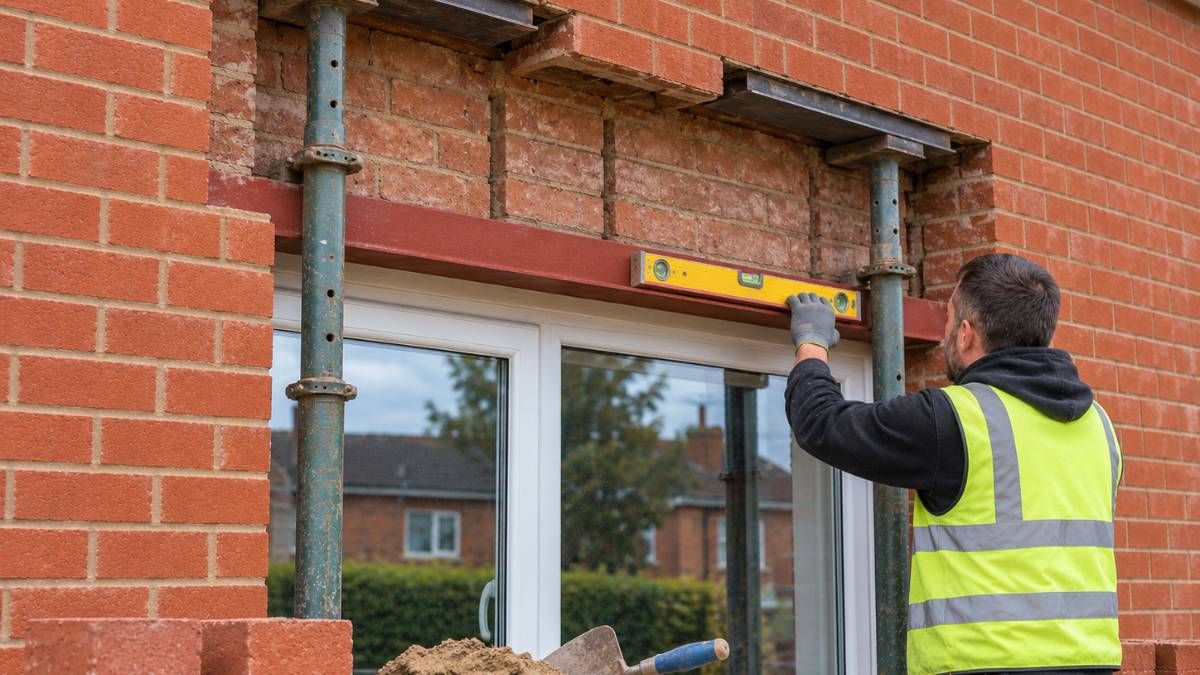
Lintel repair and replacement explained
A lintel holds up the brickwork over every window and door in your home. This guide explains how lintels fail, what the warning signs look like and how a failed one is safely replaced.
Key points
- A lintel carries the weight of the wall above a window or door opening.
- Stepped cracks rising from the corners of an opening are the classic warning sign.
- Rusting steel lintels expand as they corrode and can crack the brickwork around them.
- The wall above must be propped before any part of an old lintel is removed.
- This is structural work, so check with your local building control before it starts.
What a lintel does in your wall
A window or door is a hole in a load-bearing wall. Something has to carry the bricks above that hole and pass their weight to the solid wall at each side. That is the job of the lintel, a beam set across the top of the opening with each end resting on the brickwork at the sides.
When a lintel is doing its job, you never notice it. Often it is hidden behind a course of bricks or a decorative arch. Trouble starts when it bends, rots, rusts or cracks, because the brickwork it supports begins to move with it.
The kinds of lintel you will find in British houses
Steel lintels, including Catnic
Most modern houses use galvanised steel lintels. Catnic is a well known brand, and many people use the name for steel lintels in general. Box lintels support a single leaf of brick, while cavity lintels carry both the inner and outer leaves of a cavity wall and are shaped to throw water outwards. Steel is strong and light, but once its coating breaks down and water sits on it, it rusts.
Concrete lintels
Precast concrete lintels are common in mid-century houses and over the inner leaf of many walls. They can crack, or the steel reinforcement inside can rust, swell and push the concrete off.
Stone lintels
Many older houses have a single stone lintel, often on show as a feature over the window. Stone copes well with being squeezed but can crack across its length, particularly where the wall has moved.
Timber lintels in older homes
Some period houses have timber lintels, often hidden behind the outer face of brick. Timber is fine while it stays dry, but rot or beetle damage can leave it soft, and the brickwork above drops as it gives way.
Worried about a crack above a window?
Send a photo of the crack and the brickwork around the opening on WhatsApp. We will tell you whether it looks like a lintel problem and what we would suggest.
Warning signs that a lintel is failing
- Stepped or diagonal cracks running up from the top corners of a window or door.
- A brick arch or soldier course over the opening that has dropped or dips in the middle.
- Rust staining on the brickwork, or bricks cracked and pushed out along the line of a steel lintel.
- Windows or doors that have begun to stick or will not shut properly.
- A gap opening up between the top of the frame and the brickwork.
- Cracked plaster above the opening on the inside.
Not every crack above a window means the lintel has failed. Some are old movement that stopped long ago, or shrinkage in the mortar. A crack that is getting wider, or a line of bricks that is sagging, should be looked at sooner rather than later.
Repair or replacement: deciding what the lintel needs
Some lintel problems can be repaired. Where the lintel is sound but the brickwork around it has cracked from old, settled movement, the cracked bricks and joints can be cut out and rebuilt and the opening repointed. Light surface rust on an otherwise sound steel lintel can sometimes be cleaned back and treated.
Replacement is the answer when the lintel itself has failed. That covers steel that has rusted badly enough to swell or thin out, concrete that has cracked through or lost its cover, stone that has snapped and timber that has rotted. If the lintel no longer carries the wall, filling the cracks only hides the problem for a while.
The only way to be sure is to see the lintel itself, which can mean opening up a small area. Our lintel repair and replacement work always begins with that check.
How a lintel is replaced, step by step
Every opening is a little different, but a typical replacement in a brick wall follows this order.
- Cut holes for the supports. A few bricks are taken out above the opening.
- Prop the wall. Strong boys, steel supports that slot into those holes, are set on adjustable acrow props so they carry the brickwork above while the lintel is out.
- Take out the old work. Loose brickwork over the opening is carefully taken down, and then the old lintel is removed.
- Prepare the bearings. The brickwork at each side is cleaned up so the new lintel sits on solid, level beds.
- Bed the new lintel. The replacement is laid in mortar, checked for level and given proper bearing at each end so the load passes into sound brickwork.
- Fit a cavity tray and weep vents. In a cavity wall, a cavity tray is fitted where needed to steer water in the cavity outwards, with weep vents in the joints to let it drain away.
- Rebuild the brickwork. The wall above is relaid, reusing the original bricks where they are sound and matching ones where they are not.
- Remove the props. The props stay in until the new mortar has set enough to take the load.
- Make good and point. The prop holes are filled with brick, and the new work is pointed to match the rest of the wall.
Building regulations and a word on safety
Replacing a lintel is structural work and can need building regulations approval. Check with your local building control before the job starts. They can tell you whether an application is needed and whether the work will be inspected.
Safety note. Do not remove a lintel, or the brickwork above it, unless the wall is properly propped. Brickwork over an opening can drop without warning once its support is disturbed, and a failing lintel is often under more strain than it looks.
Why lintel work belongs with a professional
Unlike a patch of pointing, a lintel replacement can go wrong in ways that are hard to put right. The props have to be in the right places and taken up firmly, the right lintel has to be chosen for the wall and the load, and the cavity tray has to send water out of the wall rather than into the house. Poor bearing at the ends, or a lintel bedded out of level, can lead to fresh cracks.
Someone who replaces lintels regularly will also rebuild the brickwork so the repair blends in, matching the bricks, the bond and the mortar colour. Where bricks around the opening have spalled or cracked, our brickwork repairs can be done at the same time. If you have a crack over a window and are unsure what it means, send us a photo and we will give you our view.
Services mentioned in this guide
-
Brick repointing
Failing joints raked out and refilled in mortar matched to your brick.
Find out more -
Lime and mortar pointing
Breathable lime or matched mortar for Victorian, Edwardian and older homes.
Find out more -
Lintel repair and replacement
Cracked or sagging window and door heads propped, replaced and rebuilt.
Find out more -
Brickwork repairs
Spalled, cracked and loose bricks cut out and replaced to match.
Find out more -
Bricklaying
Garden walls, boundary walls, piers and small brickwork builds.
Find out more -
Not sure what you need?
Send a photo of the wall and we will tell you what it needs.
Get a free quote
More guides
Questions people ask
How can I tell if my lintel needs replacing?
Look for stepped cracks from the corners of the opening, sagging bricks above it, rust staining, or a window or door that has started to stick. A photo of the whole opening and a close-up of the crack lets us give you an opinion.
Can a lintel be replaced without taking the window out?
Often, yes. The wall above is held on props while the lintel is changed, and the frame can usually stay where it is. It depends on how the frame is fixed and what condition it is in, which we check first.
Do I need building regulations approval to replace a lintel?
It can be needed, because a lintel replacement is structural work. Your local building control can tell you whether an application is required.
How much does lintel replacement cost?
We price lintel replacement by the length of the lintel, from £1,850 for 1 to 1.5 metres up to £3,450 for 3.5 to 4 metres. Longer openings are priced from photos. The full price list by length is on our lintel repair page.
Get a quote for your lintel
Tell us which window or door is affected and send a photo if you can. Quotes are free, and larger jobs get a visit before we price them.
Get a free quote
Send us the details on WhatsApp, or by email if you prefer. We reply with a price or a time to visit.
Prefer to talk? Call 07487 625926