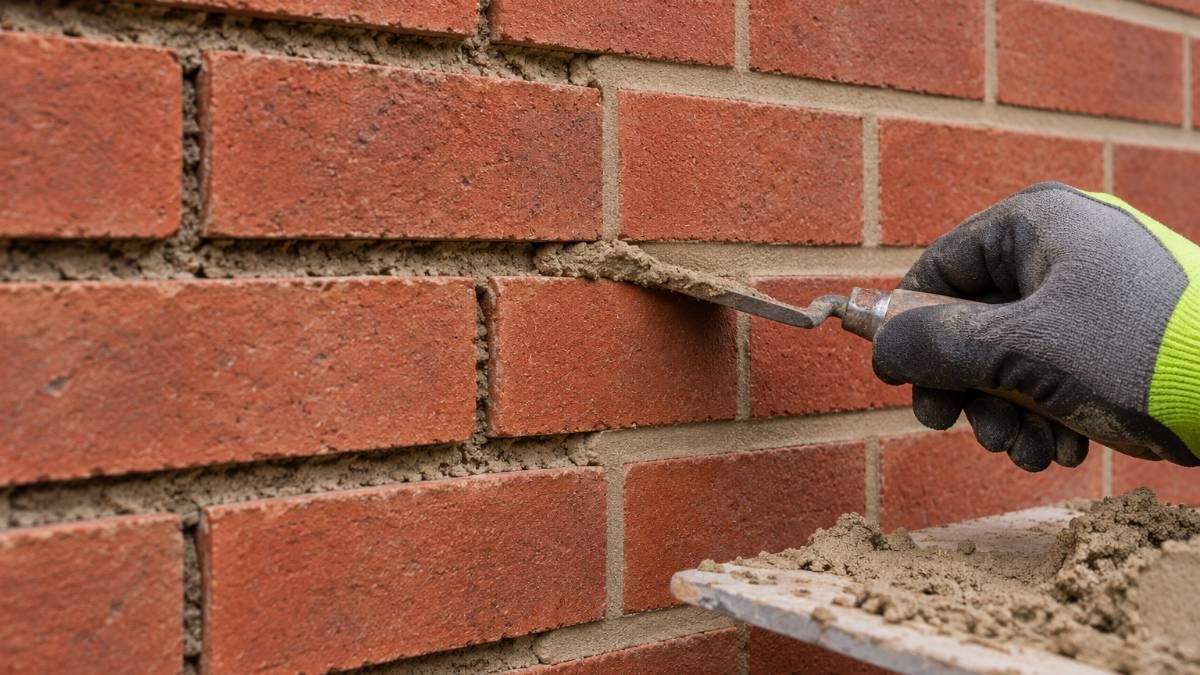
Brickwork pointing: a beginner's guide to repointing
Pointing is the mortar you see between your bricks, and it does more work than most people realise. This guide explains why it fails, how a wall is repointed properly and how to tell a good job from a poor one.
Key points
- Pointing is the outer face of the mortar, and its job is to keep rain out of the joints.
- The mortar should always be softer and more porous than the brick it sits between.
- Victorian and earlier soft-brick houses usually need lime, not a hard cement mix.
- A good repoint depends on raking the old joints out properly before anything is filled.
- Frost, heavy rain and hot sun all spoil fresh mortar, so the timing of the work matters.
What pointing does and why mortar wears out
Every brick in your wall sits in a bed of mortar. Pointing is the finished face of that mortar, the part you can see from the street. It sheds rain, seals the joint and gives the wall a neat, even look.
Mortar is meant to be the weak point of a wall. It wears away slowly so that the bricks do not have to. Wind-driven rain, frost and years of wetting and drying break down the binder until the joint turns to sand and starts to fall out. Leaking gutters and overflowing downpipes speed this up.
Once the joints open up, water gets deeper into the wall. That is when damp appears inside, brick faces start to suffer frost damage and, in the end, bricks work loose. Repointing renews the worn outer mortar before it gets that far.
Signs your wall is ready for repointing
Most of these can be checked from the ground. Look closely at the joints at eye level, then step back and check higher up, including chimneys and gable ends.
- Mortar that crumbles or scrapes out easily when you run a key along it.
- Joints sitting well back from the face of the brick, or gaps where the mortar has gone altogether.
- Sandy, powdery joints that leave grit on your fingers.
- Moss, weeds or small plants growing out of the joints.
- Bricks that move when pushed, or brick faces flaking away beside failed joints.
- Damp patches or cold draughts on the inside face of an outside wall.
A few worn joints are not a crisis. Wide areas of open joints, especially on an exposed side of the house, are worth dealing with before winter. If brick faces are already damaged, read about our brickwork repairs, because those bricks are normally cut out and replaced as part of the same job.
Not sure whether your joints need attention?
Send a photo of the wall and a close-up of the mortar on WhatsApp. We will tell you if it needs a full repoint, a small patch or nothing at all yet.
Lime or cement, and why the mortar must be weaker than the brick
The most important rule in pointing is that the mortar should be weaker and more porous than the brick. Walls move slightly with the seasons and get wet. When the joint is the softest part, it takes that movement and lets moisture dry out through it. The mortar wears and can be renewed, while the bricks stay sound.
Victorian, Edwardian and earlier houses were usually built with soft bricks and lime mortar. Repoint one of these walls in a dense cement mix and the joint becomes harder than the brick. Water that used to escape through the mortar is trapped in the brick instead, and when it freezes the brick face spalls or blows off. On older terraces you often see joints standing proud while the brick around them crumbles.
Natural hydraulic lime and lime putty
For older walls the usual choices are natural hydraulic lime, known as NHL, which sets in the presence of water and comes in different strengths, and non-hydraulic lime putty, which hardens slowly by drawing carbon dioxide from the air. The right one depends on how soft the brick is and how exposed the wall is. Our lime and mortar pointing service is for this kind of wall.
Cement mortar on modern brick
Houses built with harder, machine-made bricks generally suit a cement mortar, mixed with lime or a plasticiser so that it is not too strong. The aim is the same: a joint slightly weaker than the brick, in a colour that matches the original.
How a wall is repointed properly, step by step
A good repoint is mostly preparation. This is how professional brick repointing normally runs.
- Rake out the joints. The old mortar is cut back to a sound, even depth, deep enough for the new mortar to grip. Hard cement on old brick is removed slowly so the arrises, the edges of the bricks, are not chipped.
- Clear the dust. Loose material is brushed or blown out so the new mortar bonds to clean, sound mortar behind.
- Damp the wall. The joints are wetted so the brick does not suck the water out of the fresh mortar and leave it weak.
- Fill in layers. Mortar is pressed firmly into the joints, and deep joints are built up in more than one layer rather than in a single fill.
- Finish the joint. Once the mortar has firmed up enough to hold a shape, it is tooled to the chosen profile.
- Brush off. Surplus mortar is brushed from the brick faces once it is dry enough not to smear.
Skipping the raking out is the most common shortcut. A thin skim of new mortar over old, crumbling joints looks fine for a season and then drops out.
Joint profiles and how each one handles rain
The profile is the shape the joint is finished to. It changes the look of the wall and how well it sheds water, so matching what is already on the house is usually the best choice.
- Flush. Finished level with the brick face. Common on older and lime-pointed walls, and kind to bricks with worn, rounded edges.
- Bucket handle. A shallow curved hollow made with a rounded tool. It compacts the surface of the mortar and is one of the most common finishes on modern houses.
- Weatherstruck. Angled so the top of the joint is set back slightly and the bottom is flush, so rain runs off the face.
- Recessed. Set back from the face for sharp shadow lines. It looks crisp but leaves a small ledge where water sits, so it suits sheltered walls and hard bricks better than exposed ones.
Weather, curing and choosing when to point
Mortar needs time to cure, and the weather in the first few days decides a lot about how long it lasts. Frost can break up mortar before it sets, heavy rain can wash it out of the joints, and strong sun or a drying wind can pull the water out too fast and leave it powdery.
Lime is more sensitive than cement. It sets slowly, goes on in thinner layers and needs keeping damp and sheltered while it cures. Hessian sheeting is often hung over fresh work to shade it, keep the rain off and slow the drying. Spring to early autumn is the safest season for lime, and no pointing should be done when frost is forecast.
When DIY is fine, and how to judge a professional job
If you have a handful of open joints on a garden wall or near the ground, patching them yourself is a fair small job. Rake them out properly, damp them, use a mortar no stronger than the old one, and test the colour by letting a sample dry first. Keep it small and within easy reach.
Get the work done properly when large areas have failed, when the wall needs scaffolding or a tower, when an older house needs lime, or when bricks are already damaged. Repointing a whole side of a house with an even colour and finish takes practice.
Signs of a well pointed wall
- The new joints are an even depth and profile across the whole wall.
- Once dry, the colour sits comfortably with the brick and any original mortar.
- Brick edges are clean and unchipped, with no mortar smeared over the faces.
- The mortar is firm in the joint and is not cracking away at the edges.
- On an older house, lime has been used rather than hard cement.
If you are not sure what your wall needs, a clear photo of it is the best place to start.
Services mentioned in this guide
-
Brick repointing
Failing joints raked out and refilled in mortar matched to your brick.
Find out more -
Lime and mortar pointing
Breathable lime or matched mortar for Victorian, Edwardian and older homes.
Find out more -
Lintel repair and replacement
Cracked or sagging window and door heads propped, replaced and rebuilt.
Find out more -
Brickwork repairs
Spalled, cracked and loose bricks cut out and replaced to match.
Find out more -
Bricklaying
Garden walls, boundary walls, piers and small brickwork builds.
Find out more -
Not sure what you need?
Send a photo of the wall and we will tell you what it needs.
Get a free quote
More guides
Questions people ask
Can new mortar go straight over the old pointing?
No. Mortar spread over old joints without raking them out does not bond and soon comes away. The old mortar has to be cut back to a sound depth first.
How long should repointing last?
Done properly in the right mortar, it should last a long time. Exposure, the mix used and whether gutters and downpipes are keeping water off the wall all make a difference.
Will repointing cure damp in my house?
It helps where damp comes from rain soaking through open joints. Damp from other causes, such as a leaking gutter or a cracked downpipe, needs that cause fixing as well.
What does repointing a house cost?
Repointing the front or rear of a standard terraced house starts from £1,850 and the front or rear of a standard semi-detached house from £2,450. Height, access, scaffolding, chimneys and the state of the joints can move a job above that, and detached houses are priced from photos. Our brick repointing page sets out the full prices.
Get a price for repointing your wall
Fill in the form or send us a photo on WhatsApp. We will say which mortar suits your brick and give you a free quote.
Get a free quote
Send us the details on WhatsApp, or by email if you prefer. We reply with a price or a time to visit.
Prefer to talk? Call 07487 625926